
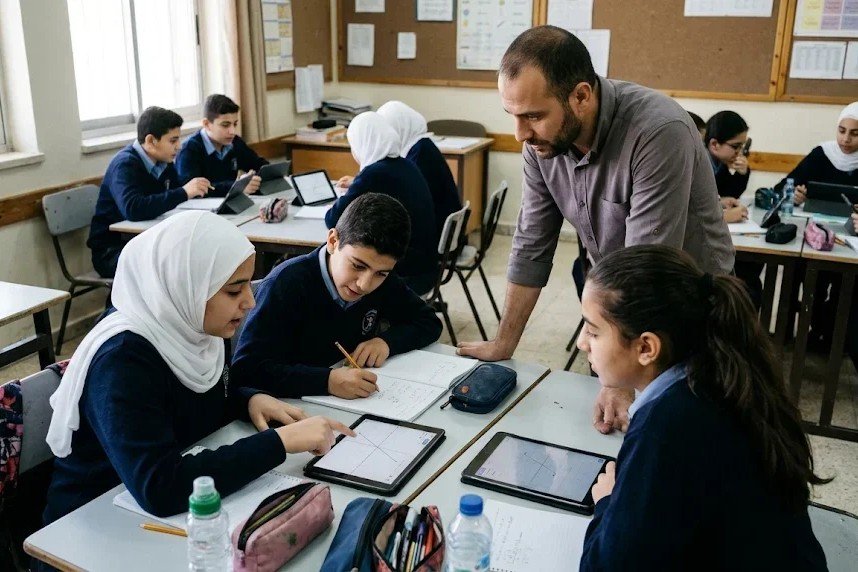
From button-clickers to digital creators. A practical course for ICT and computing teachers in IB and Cambridge schools: run a computer lab where students do the thinking, teach programming and software skills that transfer to new tasks, and guide real projects from the first plan to the final assessment.
About this course
Many students can follow the teacher’s clicks and still get stuck the moment a task looks different. This course shows how to change that: concepts before clicks, reading code before writing it, real users and audiences, and routines students can use on their own, from debugging a program to checking a source.
It is written for teachers of Cambridge IGCSE ICT (0417) and Computer Science (0478), IB MYP design, and IB DP computer science and digital society. Examples, assessment advice and command terms are matched to these programmes, and every section draws on published research in computing education. You start with a short look at your own practice, and you finish with an action plan for the next four weeks. Your progress is saved as you go.
What you will learn
- Name the learner traits IB and Cambridge share, and run a computer lab where students think, not just click.
- Plan ICT and computing units for real users and audiences, matched to IGCSE, MYP and DP requirements.
- Apply the research on how students learn computing: concepts first, reading before writing, unplugged activities and common misconceptions.
- Teach programming with PRIMM, Parsons problems, worked examples, pair programming and systematic debugging.
- Teach practical application skills (documents, spreadsheets, databases, presentations, websites) so students can use them in unfamiliar tasks.
- Guide students through the design cycle and project-based learning with real clients.
- Build computational thinking, digital citizenship, online safety and information literacy.
- Assess with MYP criteria, DP internal assessments and Cambridge mark schemes; teach AI literacy; differentiate in mixed-skill labs.
Inside the course
The course is one interactive module that contains all ten sections and the final check. Tap a section to see what it covers. To start, open the module from Course Content below.
Section 1: The learner we are buildingAbout 40 minutes
The traits IB and Cambridge share, what they look like in an ICT lesson, and how to run a computer lab where students do the thinking.
Section 2: Planning ICT and computing unitsAbout 40 minutes
The ICT and computing courses in IB and Cambridge, backward design, real users and audiences, concepts and inquiry questions, and command terms.
Section 3: How students learn computingAbout 45 minutes
The 12 principles of computing pedagogy, concepts before clicks, unplugged activities, semantic waves, cognitive load and the misconceptions students bring.
Section 4: Teaching programmingAbout 50 minutes
PRIMM, Use-Modify-Create, worked examples and subgoals, Parsons problems, live coding, and teaching students to debug on their own.
Section 5: Teaching practical application skillsAbout 45 minutes
From “follow me” to independent use: modelling, guided and independent practice for documents, databases, presentations, spreadsheets and websites, and preparing for practical tests.
Section 6: Design thinking and real projectsAbout 45 minutes
The MYP design cycle, the systems life cycle, DP computational solutions, real clients, specifications and success criteria, user testing, and managing projects.
Section 7: Computational thinking and problem solvingAbout 45 minutes
Decomposition, patterns, abstraction and algorithms; flowcharts, pseudocode and trace tables; data and databases; and computational thinking across the curriculum.
Section 8: Digital citizenship, safety and information literacyAbout 45 minutes
E-safety and security, judging online information with lateral reading and SIFT, ethics and impacts, and inquiry into digital society.
Section 9: Assessment and feedback in ICTAbout 45 minutes
Checking understanding in the lab, IGCSE assessment objectives and mark schemes, MYP design criteria, DP internal assessments, code review and feedback students act on.
Section 10: AI, academic integrity, inclusion and differentiationAbout 50 minutes
Teaching about AI and with AI, clear rules and academic integrity, mixed-skill labs, inclusion and accessibility, closing gender gaps, and teaching with few devices.
Final check15 questions
Fifteen questions based on real situations in IB and Cambridge ICT and computing classrooms. One attempt per question; the pass mark is 70%. If you don’t pass, the course points you to the sections to review before you try again.
Reflection and action planYour next four weeks
Look back at your warm-up answers, see what has changed in how you see your ICT classroom, and plan what you will do in the next four weeks.
Certificate
When you complete the course, you receive an Atheel Education certificate of completion.
How to start
- Scroll down to Course Content below.
- Click a lesson to open it.
- On the lesson page, press Start. The content opens in a new tab.
- When you finish, come back to the lesson page and refresh it to see your progress.
About Atheel Education
Atheel Education was founded by Dr. Basheer Mufleh and Dr. Ohood Al-Nakeeb. Both are Cambridge-certified teacher trainers who hold the Cambridge Train the Trainer qualification, CELTA, DELTA and a PhD.
Need help? Email info@atheeleducation.com.
- Open your bank app and choose CliQ.
- Enter the alias above, check the name, and send.
- Send us a screenshot of the receipt on WhatsApp. We'll open your course as soon as we see it.
ادفع عبر كليك: افتح تطبيق البنك، اختر كليك، أدخل الاسم المستعار 0781319255، ثم أرسل لنا صورة الإيصال على واتساب وسنفعّل الدورة حال استلامها.

 Atheel Education